












诊断
诊断概述
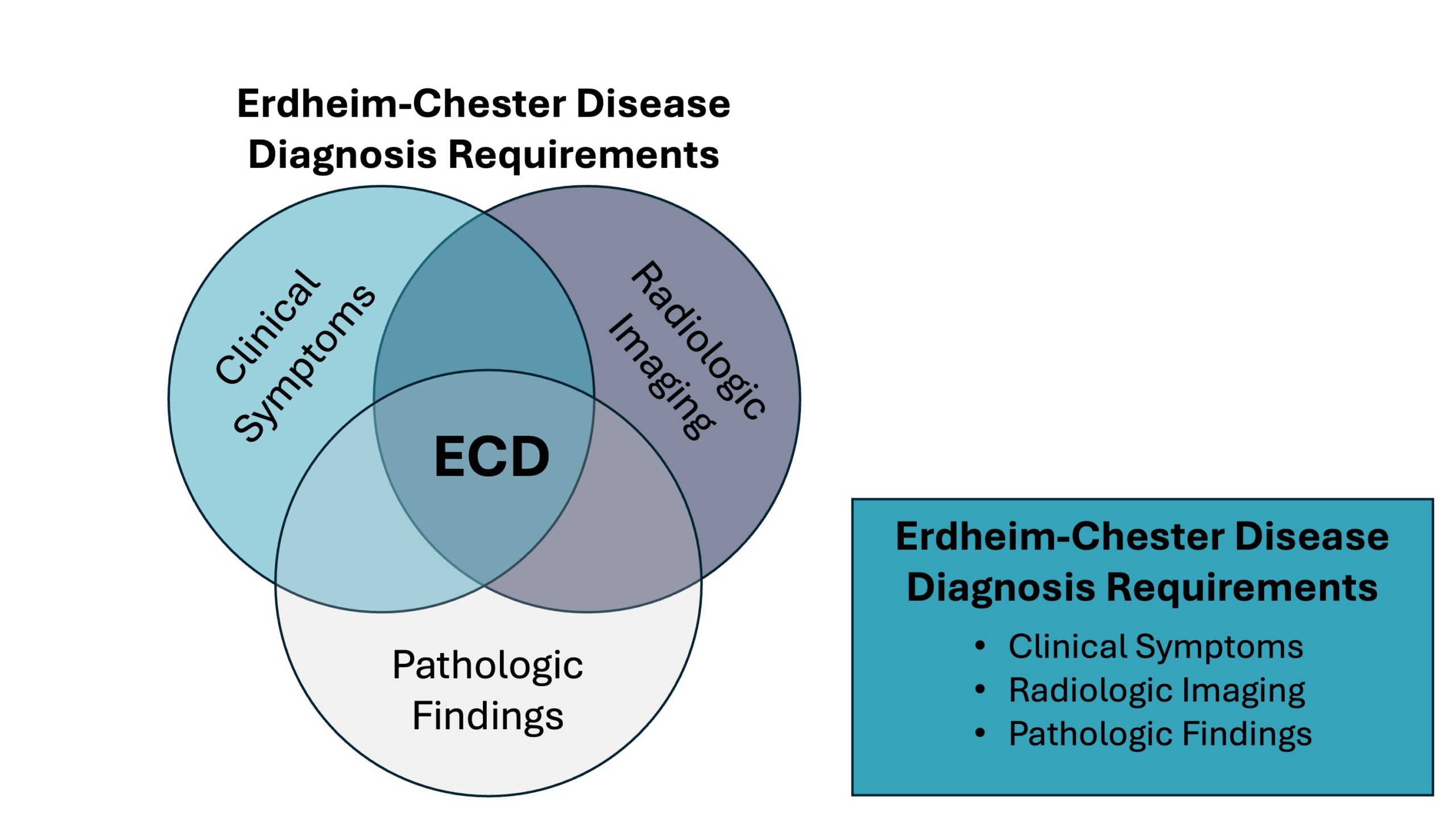
ECD is often a challenge to diagnose, given that many symptoms are not unique to ECD and that ECD has similarities to multiple other medical conditions. ECD diagnosis is often delayed by years or even decades in some cases. A definitive diagnosis is usually based on a review of ECD-involved biopsy in combination with radiologic findings from PET-CT, CT, MRI, or bone scan. Mutational testing of biopsies is also becoming increasingly important in diagnosing ECD. Nearly 90 % or more of ECD patients seem to have activation in the MAPK pathway cascade caused by a genetic mutation in the MAPK pathway, and a smaller number have changes affecting a related pathway called PI3K-AKT. These pathways help cells grow and survive, and their abnormal activation is a key feature of ECD. These mutations are believed to be acquired during a person’s lifetime (somatic) rather than inherited; therefore, these mutations are not passed through generations. If there is a suspicion of ECD, it is important for patients to be seen at specialized centers with expertise in hematology, pathology, radiology, neurology, and other subspecialties to accurately diagnose ECD and implement treatment in a timely manner.
影像学用于诊断
CT扫描、PET/CT扫描(从头到脚)、MRI、骨扫描或超声心动图等无创扫描是诊断ECD的常用检查方法。其中,PET/CT被认为对准确诊断ECD和确定疾病范围最为有效。.
活检用于诊断
如果在体内发现肿块或病变,作为ECD诊断检查的一部分,将进行组织活检。活检通常使用针头进行,但有时需要进行手术活检,以获取足够的组织样本并作出正确的诊断。 病理学家将对通过活检获得的组织样本进行研究。受ECD影响的组织通常含有成簇的泡沫样(含脂肪)组织细胞,并伴有慢性炎症征象,常可见图顿型巨细胞和纤维化。 病理学家将进行额外的染色(染料检测),以检查ECD组织细胞中是否存在特定标志物。皮肤和肾周组织通常能为诊断和分子分析提供更多有价值的信息。.
基因检测
如果怀疑患者患有ECD,病理学家会越来越多地对活检样本进行基因检测。如果发现已知的ECD突变,这将有助于做出更确切的诊断,而且通常也是为患者选择最佳治疗方案所必需的。 突变检测并不总能检测出突变,需要记住的是,即使未检测到突变,仍可确诊ECD并开展治疗。.
诊断
为了确诊或排除ECD,医生主要依据受累组织的活检结果及相关影像学检查结果。组织样本应由受过专业培训且熟悉ECD的病理学家进行审查,影像学检查结果则应由熟悉ECD的放射科医生进行评估。 病理学家、放射科医生和负责接诊的临床医生之间必须保持良好的沟通,这对确立诊断至关重要。.
对所有受累部位进行系统性检查
Once preliminary tests indicate an ECD diagnosis, it is important to make a systematic study of the organs possibly affected, including the skeleton, lungs, heart, large vessels, central nervous system, kidneys, eyes, pituitary, and/or skin. An individual with ECD needs to be seen by many specialists to obtain an accurate baseline to determine the extent of the disease. This helps the medical team monitor ECD to see if treatments are effective and to take quick action if the disease begins to progress after treatment begins. Tests that should be expected include:
-
- 血液检查。.
- 检查项目包括PET/CT、可能的骨扫描、MRI(脑部检查必不可少)、超声检查、心电图和超声心动图。.
- 软组织和/或骨组织的活检。.
- 根据涉及的部位,专科检查应包括神经科(大脑)、心脏科(心脏)、 肾脏科(肾脏)、内分泌科(激素)、皮肤科(皮肤)、眼科(眼睛)、呼吸科(肺部)、心理科(心理健康)等,可能还包括其他科室。.
检查其他相关的血液疾病
其中一些检查是针对性的,旨在排除在极少数ECD患者中发现的其他血液疾病。 研究表明,约 10% 的 ECD 患者患有其他血液癌症,包括骨髓增生异常综合征 (MDS)、骨髓增生性肿瘤 (MPN) 或慢性骨髓单核细胞白血病 (CMML)。 对这些疾病进行检测非常重要,以便制定适当的治疗和监测方案。.
更多信息
以下文献均由在ECD诊断和治疗领域具有权威地位的专家撰写。强烈建议将这些资料分享给任何不熟悉ECD且正在接诊ECD患者的医生。.
-
- 美国国家综合癌症网络(NCCN) 组织细胞瘤,第2.2021版,《NCCN肿瘤学临床实践指南》.
- 《血液杂志》上的文章,, 埃尔德海姆-切斯特病共识建议
下一页> 治疗方法
最后更新时间: 03/17/26